-
My Experience Working with AI
As I dive deeper into the world of design, I’ve had the opportunity to explore how AI tools can enhance my creative process. This journey began with the goal of designing content for Alo Yoga, where I used generative AI to create images and designs for an upcoming product drop. The experience has been eye-opening, revealing both the strengths and limitations of AI, as well as its potential to shape the future of content creation.
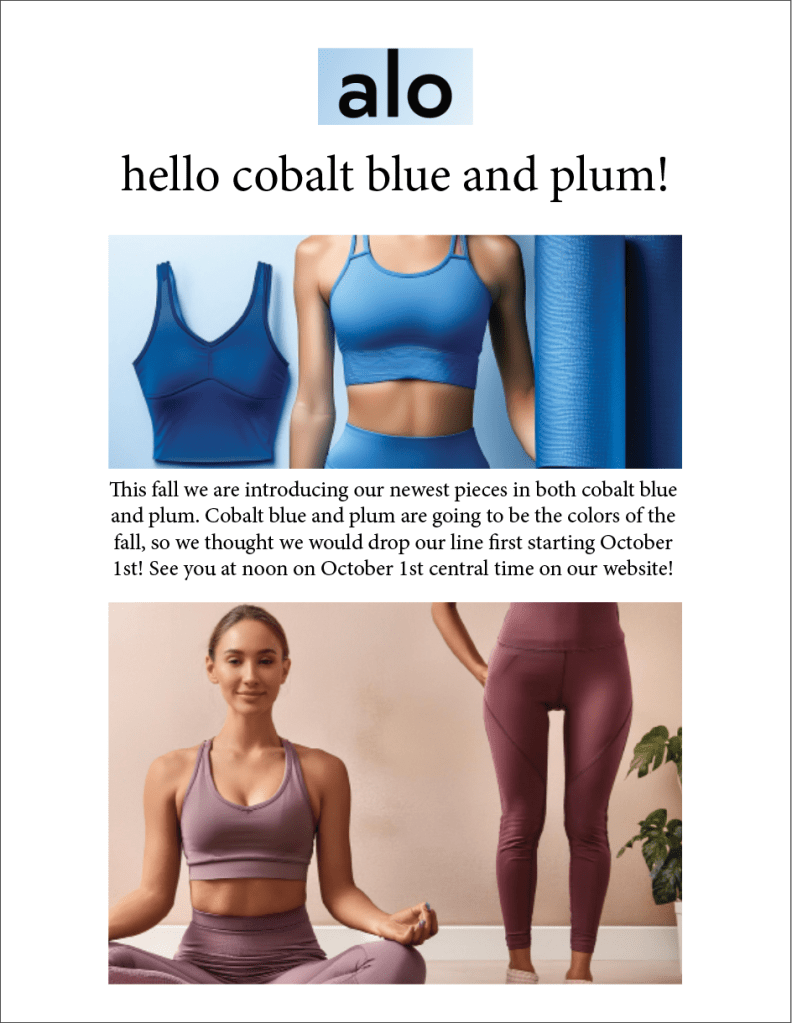
The first project I worked on involved creating an image of plum-colored yoga clothing—leggings and a bra—using AI in Photoshop. The AI did an impressive job of generating the image, but, like any tool, it wasn’t perfect. I had to edit the image several times before it matched my vision. Despite the initial setbacks, AI proved to be a useful assistant in generating the base image, which I then fine-tuned to perfection.
One of the first tools I used in Photoshop was the eraser tool to remove the distracting background of the image. While I left a plant on the right side for visual interest, I erased the rest of the background to create a clean, minimalistic look. This step was crucial in making the image polished and ready for the design.
Once the image was ready, I moved to InDesign to incorporate the generated image into my layout. I created a simple rectangle frame for the plum-colored yoga clothing image and another frame for my logo, which I had designed earlier in Photoshop. The process was seamless once I had the right images, and the pieces began to fall into place.
Encouraged by the success of my first design, I wanted to take it a step further by creating a second version with cobalt blue yoga clothing. I thought it would be a smart move for an athletic brand like Alo to release new products in multiple colors, and I wanted to replicate that approach in my design.
Generating this new image wasn’t as straightforward as I hoped. Despite several attempts to arrange the wording and regenerate the design, it was challenging to get the AI to produce a modern, organized image of yoga clothes in the exact shade of blue I envisioned. It also proved difficult to remove human faces from the images, which I didn’t want for this design. After experimenting with different inputs and rephrasing my prompts, I was finally able to get the image I wanted.
Once I had the final AI-generated image, I added a white, paper-like frame around it to give the design a clean, professional feel. I then created text boxes to announce the new color drop and when it would be available—tomorrow at noon, Central Time. Ensuring that my chosen fonts and design elements were consistent with the overall look of the project was important, so I made sure to use the fonts I had selected for the campaign.
Through this project, I realized that AI can be a fantastic tool for enhancing an initial design idea, but it’s not without challenges. While AI can quickly bring a vision to life, it often requires multiple iterations to get it just right. I found myself tweaking the wording or regenerating images many times before achieving the perfect result. It can be a time-consuming process, but with patience and persistence, the outcomes are often worth the effort.
What stood out to me is that AI has the ability to push your creativity in unexpected ways. It can take a simple idea and transform it into something more complex and refined. This ability to expand on an initial vision was a huge advantage, as it allowed me to explore variations of my design that I might not have considered otherwise.
Despite its strengths, I encountered a few limitations while working with AI. One major challenge was the inability to preview the design before it was fully generated. If I could have seen a preview, I could have made quick adjustments or reworded my prompts to better reflect my desired outcome. This would have saved time and allowed for a more efficient workflow.
Additionally, while AI is incredibly powerful, it’s not perfect. It can’t read your mind and interpret exactly what you see in your head. There were times when the AI’s interpretation of my prompts didn’t quite match what I envisioned. But with some tweaking and patience, I was able to guide it closer to my intended result.
-
The Future of AI in Design
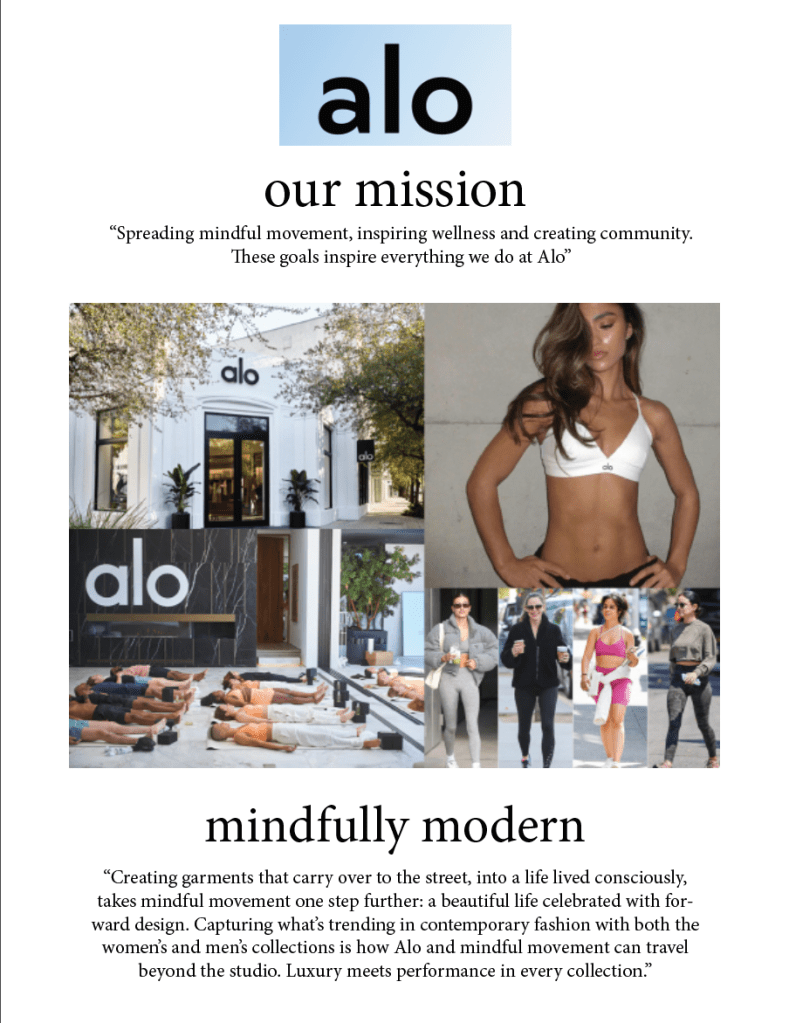
Looking ahead, I see endless potential for AI in the world of content creation. In recent years, AI tools have become increasingly sophisticated, offering a wealth of opportunities for designers, marketers, and creators across industries. One of the most exciting aspects of AI is its ability to speed up the design process, helping designers iterate on concepts quickly and efficiently. Instead of spending hours or even days refining an idea, AI can generate initial drafts and variations in a matter of minutes. This allows designers to focus more on creativity and strategy, rather than getting dragged down in the technicalities of design work.
AI tools can also spark new creative ideas by suggesting design elements and offering variations that a designer might not have considered on their own. The creative process can often be limiting, with designers getting stuck in familiar patterns or techniques. However, AI has the ability to push those boundaries by presenting fresh ideas that can help expand a project in unexpected directions. For instance, AI can generate countless iterations of a design, giving a designer new angles or perspectives to consider. This opens up opportunities to experiment with combinations of colors, styles, and layouts that may have otherwise been overlooked. AI can serve as a source of inspiration, pushing the designer to think beyond their typical comfort zone.
In addition to these creative benefits, AI also has the potential to democratize design. Many people are interested in creating high-quality content, but they may not have the technical skills or expertise to do so. AI tools help bridge that gap by making professional-grade design accessible to everyone, regardless of their experience level. With AI, someone with limited design knowledge can create polished and visually appealing content, such as social media graphics, advertisements, or website layouts. As these tools continue to improve, they will become even more intuitive, allowing users to create sophisticated designs with minimal effort. I believe this could drastically change how businesses and individuals approach content creation, making it more inclusive and accessible.
While AI’s capabilities are impressive, there are still some limitations. One of the main challenges I encountered was the inability to preview the results of a design before it was fully generated. While some AI tools offer real-time previews or partial renderings, others can only show the final product after the process is complete. This can make it difficult to make quick adjustments and may result in wasted time if the generated design isn’t quite what was expected. With more advanced tools, I would love to see a preview feature that allows for more flexibility and faster revisions.
Despite these limitations, the overall experience of using AI in design has been incredibly rewarding. I’ve learned a great deal about how AI can enhance the creative process, and I’ve developed a newfound appreciation for the potential it holds in the future of design. The more I work with AI, the more I realize how important it is to approach it as a tool that complements, rather than replaces, human creativity. AI can quickly generate ideas and execute technical tasks, but it still requires the human touch to guide it in the right direction. The key is understanding that AI works best when it is used as a supplement to human ingenuity, not as a substitute.
Having used AI in my project, I can confidently say that I will continue to incorporate it into my design work moving forward. Whether for generating initial concepts, exploring different design variations, or streamlining the creative process, AI has proven to be an invaluable resource. My past experience using AI for social media captioning for a smaller agency introduced me to its writing capabilities, but this project taught me how to generate and manipulate images with AI—an exciting and highly relevant skill for the future of content creation.
In a future firm or agency, I would definitely continue using AI tools, particularly for tasks like generating initial design drafts or brainstorming new concepts. I see it as a way to streamline workflows and increase productivity. However, it’s important to strike the right balance between AI and manual methods. While AI is a powerful tool, it cannot replace the creative thinking, intuition, and emotional intelligence that human designers bring to the table. With the right balance, AI and human creativity can work hand-in-hand to push the boundaries of design and content creation.
Overall, working with AI in my PRCM 4020 Style and Design class was an incredibly rewarding experience. I’m excited to see how AI continues to evolve and how it will be further integrated into the creative industry. As the technology advances, it’s likely that the role of AI in design will expand, offering even more possibilities to push the boundaries of what’s possible in content creation.
 Home
Home 